Have you ever received a simple 👍 in a text and wondered, “What does this really mean?” The thumbs up emoji may look straightforward, but its meaning can change depending on who sends it, what was said before it, and the mood of the conversation.
Sometimes, 👍 means “okay,” “sure,” “got it,” or “sounds good.” In other situations, it can show agreement, support, approval, or even a quick way to end a conversation.
A thumbs up from a friend may feel casual and friendly, while the same emoji from a crush, partner, coworker, or someone you barely know can carry a slightly different tone.
What Does the Thumbs Up Emoji Actually Mean?
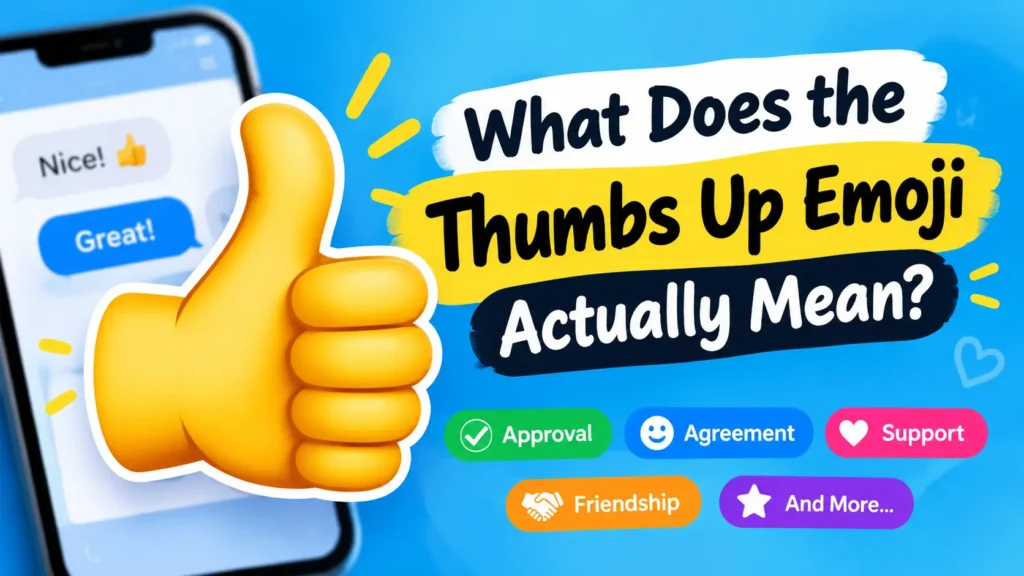
At its core, the thumbs up emoji is a symbol of approval or agreement. It’s basically a digital handshake , a quick nonverbal “yes” you can send instead of typing anything out.
Officially, it’s meant to represent:
- Approval (“sounds good”)
- Agreement (“yes, I’m in”)
- Acknowledgment (“I saw your message”)
- Encouragement (“nice job”)
That’s the textbook definition. In real life, though, people use it for way more than that, and the tone can shift completely based on context.
Thumbs Up Emoji Meaning in Text Messages
In texting specifically, the 👍 usually works as a low-effort confirmation. It’s the emoji version of nodding your head instead of saying “yes” out loud.
Common uses in texts include:
- Confirming plans (“See you at 7?” → 👍)
- Acknowledging you read something without needing to reply in detail
- Showing you’re on board with an idea
- Ending a conversation politely without ghosting
Here’s the thing: because it takes zero effort to send, the meaning behind it depends heavily on the relationship between the two people texting. A 👍 from your mom confirming dinner plans feels completely different from a 👍 from someone you’ve been texting all day who suddenly goes quiet after sending it.
Does the Thumbs Up Emoji Mean Different Things in Different Contexts?
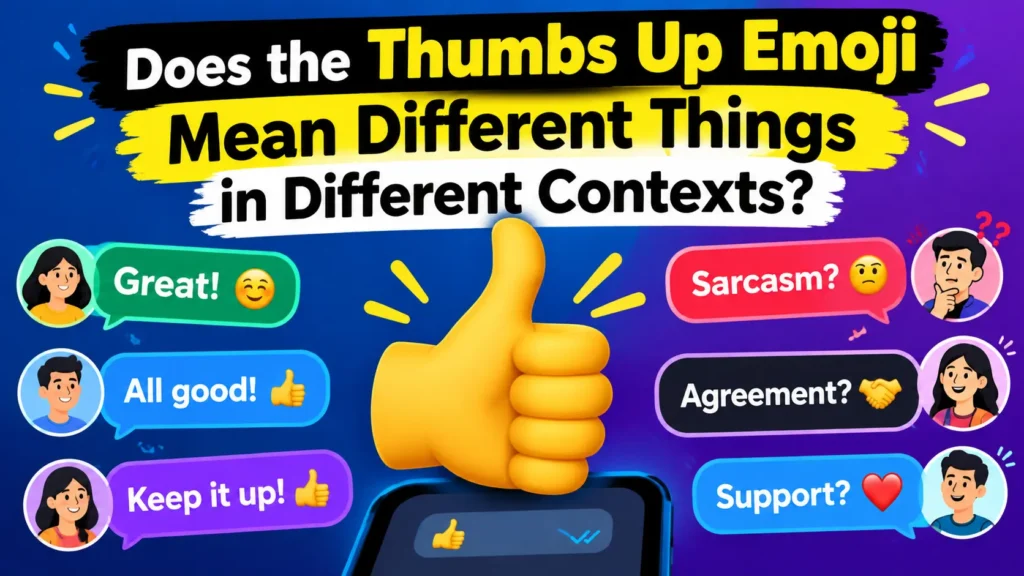
Yes , and this is the most important thing to understand about this emoji. There’s no single fixed meaning. The 👍 shifts based on:
- The relationship (coworker, friend, family, crush, partner)
- The conversation before it (was it a question, a joke, an emotional message?)
- The platform (text, Slack, Instagram, group chat)
- The timing (instant reply vs. hours later)
- The person’s usual texting style (do they normally text more or less?)
The same emoji can mean “absolutely, let’s do this” or “I don’t really want to talk about this right now, but okay.” Context is everything.
In a Work or Professional Setting
Here, the 👍 is almost always neutral and efficient. It simply means “received” or “approved.” No romantic or emotional undertone , it’s just quick communication.
In a Casual Friendship
Between friends, it usually means genuine agreement or light acknowledgment. It’s friendly, low-stakes, and doesn’t usually carry hidden meaning.
In a Group Chat
In group chats, a 👍 often just means someone saw the message and agrees, without wanting to add to the conversation. It’s a way to participate without derailing the chat.
In a Romantic or Flirty Conversation
This is where things get tricky. A 👍 in a flirty or emotionally loaded conversation can feel underwhelming, especially if you were expecting a longer or warmer response.
Thumbs Up Emoji Meaning From a Girl
When a girl sends a 👍, the meaning depends heavily on her texting habits and the nature of the conversation.
- If she texts in short bursts generally, a 👍 is probably just her normal style , not a red flag.
- If she usually sends detailed, expressive texts and suddenly replies with just 👍, it might signal she’s busy, distracted, or less interested in continuing that specific topic.
- In a new dating context, a solo 👍 to a longer message can sometimes feel like a polite but low-effort response , not necessarily bad, but not enthusiastic either.
It’s not automatically a bad sign. Some people just default to quick replies when they’re busy, tired, or multitasking. The key is comparing it to her usual pattern, not judging it in isolation.
Thumbs Up Emoji Meaning From a Guy
From a guy, the 👍 tends to lean toward efficiency more often than emotional distance , though it can still feel dismissive depending on the context.
- Many guys use 👍 simply because it’s fast and gets the point across.
- In casual or logistical texts (“Can you grab milk?” → 👍), it’s completely neutral.
- In a conversation where more emotional engagement was expected, a 👍 can come across as low effort or like he’s not that invested in the conversation at that moment.
Again, this isn’t a universal rule. Some guys just aren’t big texters, and a 👍 is simply their normal way of replying, not a sign of disinterest.
Thumbs Up Emoji Meaning From a Crush or Romantic Partner
This is where the 👍 causes the most overthinking, and understandably so.
From a Crush
If you send something meaningful, funny, or a bit vulnerable, and your crush replies with just 👍, it can feel deflating. It might mean:
- They’re busy and will respond properly later
- They saw it but didn’t know how to respond
- They’re not as invested in the conversation as you are
- It’s genuinely just their texting style
One 👍 isn’t enough data to draw a conclusion. Look at the overall pattern , do they initiate conversations, ask questions, and text you outside of replying to your messages? That tells you more than a single emoji ever could.
From a Partner
In an established relationship, a 👍 is usually harmless and just reflects daily life , confirming plans, agreeing to something, or a quick “got it” while busy. It’s only worth noticing if it becomes a consistent replacement for actual conversation, especially during discussions that matter.
Friendly vs Romantic Meaning: How to Tell the Difference
| Context | Likely Meaning | Should You Worry? |
| Confirming plans (any relationship) | “Yes, that works” | No |
| Reply to a joke | “Haha, agreed” or acknowledgment | No |
| Reply to a deep or emotional text | Possible disinterest or being busy | Maybe , check the pattern |
| Reply to a flirty message | Lukewarm response | Depends on their usual style |
| Group chat reply | Passive agreement | No |
| Reply after a long gap | Distraction or lower priority reply | Possibly |
The biggest giveaway isn’t the emoji itself , it’s whether it matches the emotional weight of what you sent. A 👍 to “Sounds good, see you at 8” is totally normal. A 👍 to “I really enjoyed talking to you last night” feels mismatched, and that mismatch is usually what causes confusion.
Thumbs Up Emoji Meaning on Social Media
On platforms like Instagram, Facebook, or Twitter/X, the 👍 works a bit differently than in texting.
- As a comment: It usually shows quick support or agreement with a post, similar to a like but slightly more personal.
- As a reaction: On platforms with reaction buttons, it often functions the same as hitting “like.”
- In replies to stories or posts: It’s a fast way to acknowledge something without writing a full comment.
Unlike texting, social media use of the 👍 rarely has emotional weight. It’s more about quick, public-facing approval than personal connection.
Common Situations Where the Thumbs Up Emoji Is Used
- Confirming a meeting time or plan
- Agreeing to an idea or suggestion
- Acknowledging a message without needing a full reply
- Showing support for something someone shared
- Ending a conversation on a polite, neutral note
- Replying quickly while busy or multitasking
- Approving work-related requests or tasks
Realistic Text Message Examples
Example 1 , Logistics (Neutral)
“Can you pick up the kids at 3?” 👍
This is purely functional. No hidden meaning here.
Example 2 , Casual Agreement (Friendly)
“We’re grabbing food later, you in?” 👍
Simple, easygoing agreement between friends.
Example 3 , Possible Mismatch (Worth Noticing)
“I had a really good time with you last night.” 👍
This is the kind of reply that can feel underwhelming, since the emoji doesn’t match the emotional tone of the message.
Example 4 , Work Context (Professional)
“I’ll send the report by end of day.” 👍
Quick, efficient, and appropriate for a work setting.
How to Respond to a Thumbs Up Emoji
If you get a 👍 and aren’t sure how to respond, here are a few solid options depending on the situation:
- If it’s just confirming plans: No response needed, or a simple “great!” works.
- If it feels like a low-effort reply to something meaningful: You can gently follow up, like “Haha okay, just checking you saw that 😊” This keeps things light without overreacting.
- If you want more engagement: Ask a direct question instead of leaving it open-ended. Questions are harder to reply to with just an emoji.
- If it’s from a crush and you’re unsure: Don’t overanalyze a single reply. Watch the overall pattern instead of reacting to one message.
Similar Emojis and How They Differ
| Emoji | Meaning | How It Differs from 👍 |
| 👌 OK Hand | “Perfect” or “understood” | Feels more casual, sometimes seen as a bit dismissive too |
| ✅ Check Mark | “Done” or “confirmed” | More task-oriented, less personal |
| 🙌 Raised Hands | Celebration or excitement | Much more enthusiastic than 👍 |
| ❤️ Heart | Affection or strong approval | Carries emotional warmth 👍 doesn’t have |
| 😊 Smiling Face | Warmth, friendliness | Softer and more personal than a plain 👍 |
| 👍🏻/👍🏽/👍🏾 (skin tone variants) | Same meaning, just personalized | No difference in meaning, purely visual preference |
The main thing that sets 👍 apart from these is its neutrality. It confirms something without adding warmth or excitement, which is exactly why it can sometimes feel cold in the wrong context.
Common Misunderstandings About the Thumbs Up Emoji
“A thumbs up means someone is mad at me.” Not usually true. It’s often just a fast, low-effort reply , especially from people who text briefly by nature.
“It always means someone is losing interest.” Not necessarily. Compare it to their normal texting habits before assuming anything.
“It’s a rude way to end a conversation.” In many cases, it’s just a polite way to acknowledge something without needing to keep the conversation going, especially in busy moments.
“Only older people use it.” While it’s true that younger generations sometimes see 👍 as blunt or slightly passive-aggressive (especially at work), it’s still widely used across all age groups in everyday texting.
“It always means agreement.” Usually, yes , but in some tones, especially sarcastic ones, it can also mean “fine, whatever,” depending on the conversation.
Final Thoughts
The 👍 emoji is one of the simplest emojis out there, but its meaning really does depend on the situation. In most everyday texts, it’s just a quick, harmless way to say “okay” or “got it.” In emotionally loaded conversations, especially with a crush or partner, it can feel underwhelming if it doesn’t match the tone of what was said.
The best way to read it is to look at the bigger picture , the relationship, the conversation before it, and how that person normally texts , rather than judging it as one isolated message. Most of the time, a 👍 is exactly what it looks like: a quick, easy way to say yes.
Frequently Asked Questions
1. What does 👍 mean from a guy I’m texting? It usually means agreement or acknowledgment. If he’s generally a brief texter, it’s likely just his normal style rather than a sign of disinterest.
2. Why did she just send a thumbs up instead of a real reply? She might be busy, multitasking, or simply confirming something quickly. Compare it to how she usually texts before assuming it means something negative.
3. Is a thumbs up emoji rude? Not inherently. In casual or work contexts, it’s efficient and neutral. It can feel rude only when used in response to something emotional or important.
4. Does 👍 mean someone likes you? Not on its own. It’s a neutral acknowledgment, not a romantic signal. Look at the overall conversation pattern for actual interest, not a single emoji.
5. What’s the difference between 👍 and 👌? 👍 generally means agreement or confirmation, while 👌 leans more toward “perfect” or “understood.” Both can feel slightly blunt depending on context, but they’re used in similar low-effort situations.